
A Two-Toed Sloth’s Slow and Steady Recovery
Two-toed sloth Luca is one of more than 120 animals the Minnesota Zoo rescued from SeaQuest when it closed in February 2025. Shortly after arriving at the Zoo, Luca began to experience periods of poor appetite, lethargy, and weight loss that led to hospitalization and supplemental feeding.
The Zoo’s veterinary team began an extensive investigation to determine the source of his illness. Regular radiographs did not reveal what was wrong with Luca’s stomach, so the team turned to advanced imaging techniques.
Luca was given a whole-body CT scan at a local veterinary specialty hospital. The scan showed what appeared to be a tubular object obstructing his stomach.
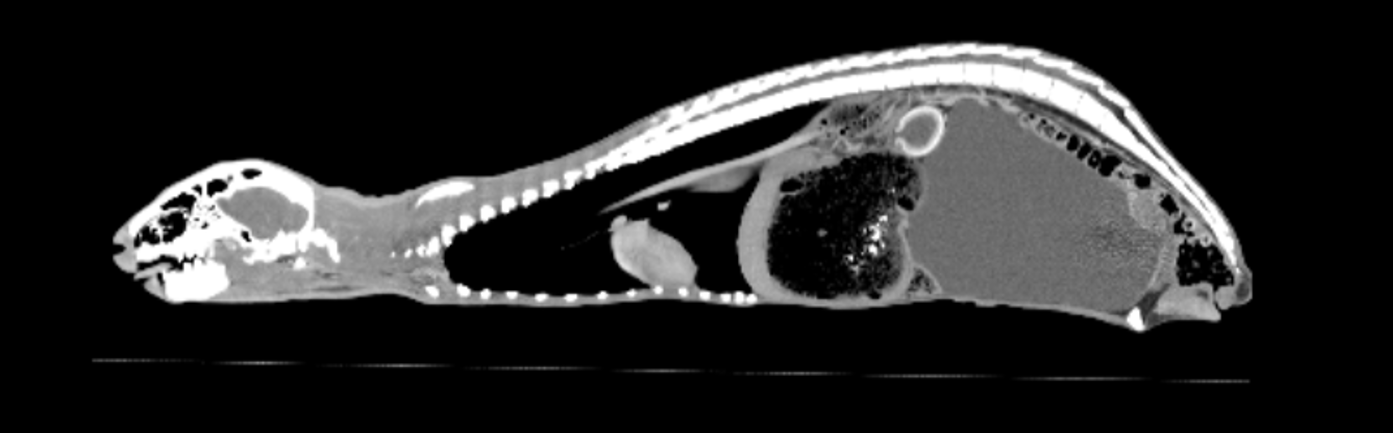
Two-toed sloth Luca’s CT scan, revealing a coil of mineralized tissue in his stomach, appearing in the image as a white circle.
But instead of a foreign object, surgery revealed the mass to be abnormal tissue in Luca’s stomach. Samples of the tissue showed significant mineralization of his stomach lining, likely caused by an incorrect diet containing too much vitamin D at his prior facility. Unfortunately, this is a common finding in sloths from non-accredited facilities.
This condition can be very serious for sloths, but Luca has been making a slow and steady recovery. With intensive supportive care, dietary changes, and continuous medical management, his condition gradually improved.
By June 2026, Luca had regained weight and resumed normal activity levels. In July, he was introduced to fellow sloth and SeaQuest rescue, Chewie. Today, you can see both sloths living together and exploring their shared habitat on the Zoo’s Tropics Trail.
Luca’s condition could not have been diagnosed without advanced CT imaging. And thanks to generous Foundation donors, the Zoo’s new future animal hospital will be equipped with its own CT scanner, meaning animals will no longer need to be transported off-site to receive this essential imaging, reducing stress for people and animals alike.